Special Issue
This issue advances a more expansive financial capability framework that integrates policies that help people develop their financial capability: the combination of personal and governmental capabilities, including equitable access to financial institutions, income, and wealth-building resources. Five policy tools are used: Child Development Accounts, Guaranteed Income, Free College, Baby Bonds, and comprehensive financial education. Ultimately, the issue invites policymakers and scholars to imagine—and demand—a revolution in social welfare policy that aligns with the American ideal of the right to the pursuit of financial happiness.
-
-
Audio Summaries
-
- Paper 2: Timing Wealth Building to Maximize Return on Degree
- Paper 3: Redesigning Social Welfare: Presenting a New Asset Poverty Measure
- Paper 4: Testing a Social Welfare Theory of Financial Capability: Personal and Governmental
Capabilities - Paper 5: Ensuring Financial Happiness through an Integrated Social Welfare System
Acknowledgment:
In the preparation of the research briefs and audio files, Google's NotebookLM was used as an AI assistant to help synthesize information from the provided research articles and structure key concepts.
This special issue and accompanying materials could not have been done without the generous support of Annie E. Casey Foundation and the Charles Stewart Mott Foundation. These organizations are not responsible for the quality or accuracy of this special issue or its associated products, which are the sole responsibility of the authors, nor do they necessarily agree with any or all the report’s content.
Using Wealth and Income Policies to Forge a New Social Contract: Giving People Something to Live For
Sept. 16th – 17th, 2024

Post Conference Materials:
Individual Sections of Post Conference Report - Coming Soon:
- Introduction (Provides rationale for why assets and income are needed for ending poverty)
- Key Takeaways for each brief included in the full report
- Policy Recommendations
- Discussion (Provides insight on how CSAs can be used to deliver recommendations and additional information on the importance of combining income and asset strategies for ending poverty)
All references for individual sections can be found in the full report.
We would like to thank Annie E. Casey, Charles Stewart Mott Foundation, McKnight Foundation, and the University of Michigan’s School of Social Work for their financial support to make this event possible.
We would also like to thank our co-sponsors (Center for Social Development, Center for Guaranteed Income Reesarch and Poverty Solutions) for helping to bring together this collection of researchers, practitioners, and policy makers. This conference could not have taken place and been the success that it was without their collaboration.
Child Savings Accounts and Other Tax-Advantaged Accounts Benefiting American Children
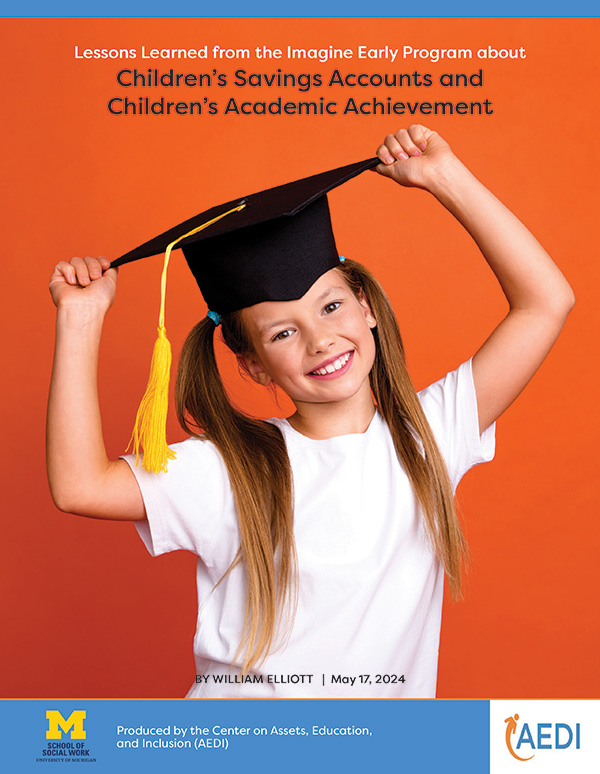
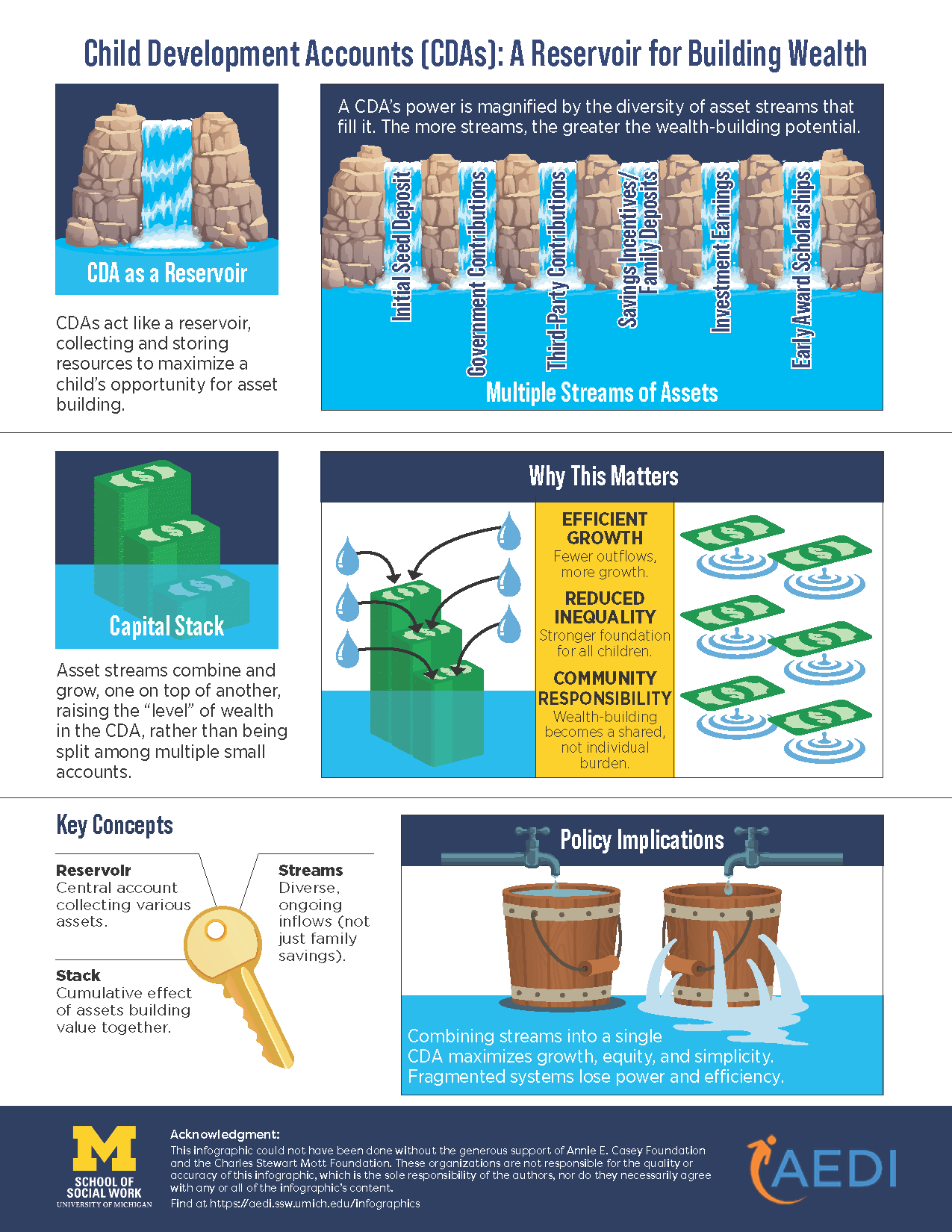
In 2016, the Community Foundation of Wabash County (CFWC) created the Imagine Early program (first known as Promise Scholars then more recently as the Early Award Scholarship Program). Imagine Early, a type of Children’s Savings Account (CSA) program, expands on traditional CSAs by providing merit-based educational scholarships. The scholarships are earned by students through their efforts in school and are awarded into their Community Foundation Imagine Early Fund.
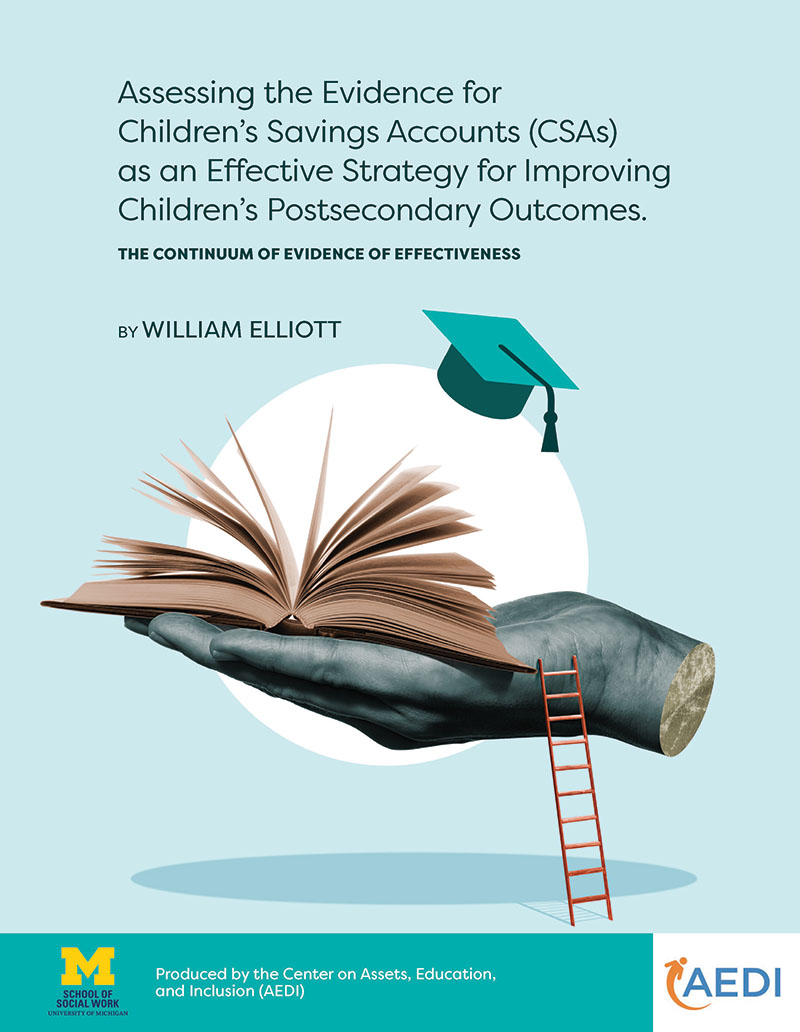
In this paper, the author organizes the history of our understanding of CSAs impact on college as a series of “evolutions” advancing the field. In addition, the paper uses a continuum of evidence of effectiveness to better assess the evidence on Children’s Savings Account’s (CSA) effectiveness at improving children’s college outcomes.
Doorway to Multiple Streams of Assets
Report & Resources
Report:
Case Studies:
- Case Study 1: Keystone Scholars
- Case Study 2: Early Award Scholarship (EAS)
- Case Study 3: Oakland Promise (OP)
- Case Study 4: CollegeBound Saint Paul
- Case Study 5: New York City Kids RISE
- March 29th Webinar Recording
Podcast:
Webinar:
 Facebook
 Twitter